
Daytona Beach Property Search

Buy Or Sell With James Jestes and eXp Realty

  • Menu
  • Home
  • Buy
  • Sell Your Home
  • Blog
  • About
  • Contact

Home Prices: What Happened in 2020? What Will Happen This Year?

Home Prices: What Happened in 2020? What Will Happen This Year? | Simplifying The Market

The real estate market was on fire during the second half of 2020. Buyer demand was way up, and the supply of homes available for sale hit record lows. The price of anything is determined by the supply and demand ratio, so home prices skyrocketed last year. Dr. Lynn Fisher, Deputy Director of the Federal Housing Finance Agency (FHFA) Division of Research and Statistics, explains:

“House prices nationwide recorded the largest annual and quarterly increase in the history of the FHFA Home Price Index. Low mortgage rates, pent up demand from homebuyers, and a limited housing supply propelled every region of the country to experience faster growth in 2020 compared to a year ago despite the pandemic.”

Here are the year-end home price appreciation numbers from the FHFA and two other prominent pricing indexes:

  • Federal Housing Finance Agency House Price Index Report: 10.8%
  • CoreLogic Home Price Insights: 9.2%
  • S&P Case-Shiller U.S. National Home Price Index: 10.4%

The past year was truly a remarkable time for homeowners as prices appreciated substantially. Lawrence Yun, Senior Economist at the National Association of Realtors (NAR), reveals:

“A typical homeowner in 2020, just by being a homeowner, would have accumulated around $24,000 in housing wealth.”

What will happen with home prices this year?

Many experts believe buyer demand will soften somewhat as mortgage rates are poised to bump up slightly. Some also believe the inventory challenge will ease as more listings come to market this year.

Based on this, most forecasters anticipate we’ll see strong appreciation in 2021 – but not as strong as last year. Here are seven prominent groups and their projections:
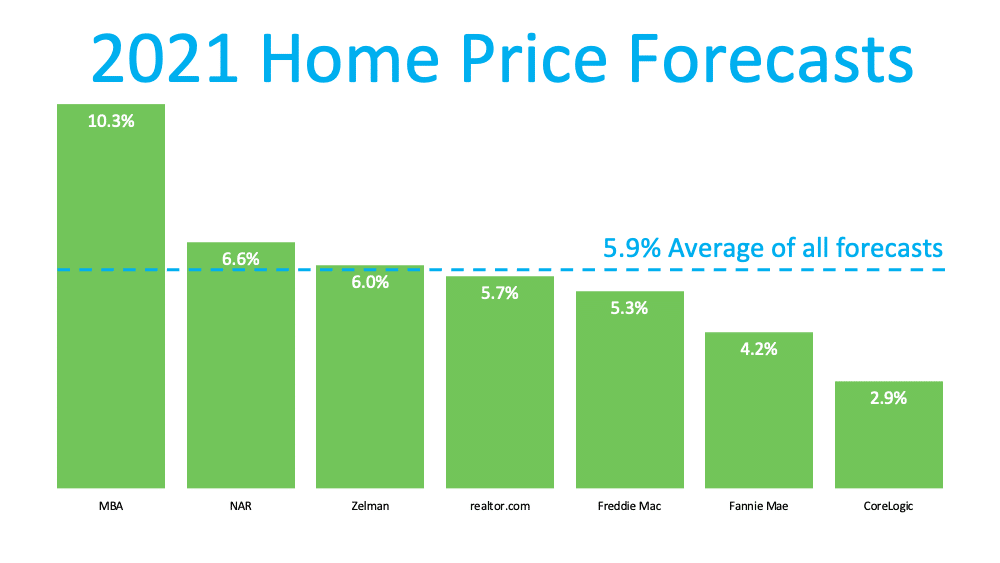
Home Prices: What Happened in 2020? What Will Happen This Year? | Simplifying The Market

Bottom Line

Home price appreciation will be strong this year, but it won’t reach the historic levels of 2020. Let’s connect if you’d like to find out what your house is currently worth in our local market.

Continue reading…

Posted in: Blog, For Sellers, Housing Market Updates, Move-Up Buyers, Pricing

What Are the Benefits of a 20% Down Payment?

What Are the Benefits of a 20% Down Payment? | Simplifying The Market

If you’re thinking of buying a home this year, you may be wondering how much money you need to come up with for your down payment. Many people may think it’s 20% of the loan to secure a mortgage. While there are plenty of lower down payment options available for qualified buyers who don’t want to put 20% down, it’s important to understand how a larger down payment can have great benefits too.

The truth is, there are many programs available that allow you to put down as little as 3.5%, which can be a huge benefit to those who want to purchase a home sooner rather than later. Those who have served our country may also qualify for a Veterans Affairs Home Loan (VA) and may not need a down payment. These programs have really cut down the savings time for many potential buyers, enabling them to start building family wealth sooner.

Here are four reasons why putting 20% down is a good plan if you can afford it.

1. Your interest rate may be lower.

A 20% down payment vs. a 3-5% down payment shows your lender you’re more financially stable and not a large credit risk. The more confident your lender is in your credit score and your ability to pay your loan, the lower the mortgage interest rate they’ll likely be willing to give you.

2. You’ll end up paying less for your home. Continue reading…

Posted in: Blog, Buying Myths, Down Payments, First Time Home Buyers, For Buyers, Move-Up Buyers

It’s a Sellers’ Market [INFOGRAPHIC]

It’s a Sellers’ Market [INFOGRAPHIC] | Simplifying The Market

It’s a Sellers’ Market [INFOGRAPHIC] | Simplifying The Market

Some Highlights

  • Over the past year, homeowners have gained an unprecedented opportunity to sell with great success while buyer demand is soaring.
  • With homes selling twice as fast as they did last year at this time, getting multiple offers, and rising in price, homeowners are in the driver’s seat.
  • Let’s connect today if you’re ready to learn about the leverage you have as a seller in today’s housing market.

Continue reading…

Posted in: Blog, For Sellers, Housing Market Updates, Infographics, Move-Up Buyers, Pricing

Are There Going to Be More Homes to Buy This Year?

Are There Going to Be More Homes to Buy This Year? | Simplifying The Market

If you’re looking for a home to purchase right now and having trouble finding one, you’re not alone. At a time like this when there are so few houses for sale, it’s normal to wonder if you’ll actually find one to buy. According to the National Association of Realtors (NAR), across the country, inventory of available homes for sale is at an all-time low – the lowest point recorded since NAR began tracking this metric in 1982. There are, however, more homes expected to hit the market later this year. Let’s break down the three key places they’ll likely come from as 2021 continues on.

1. Homeowners Who Didn’t Sell Last Year

In 2020, many sellers decided to pause their moving plans for a number of different reasons. From health concerns about the pandemic to financial uncertainty, plenty of homeowners decided not to move last year.

Now that vaccines are being distributed and there’s a light at the end of the COVID-19 tunnel, it should bring some peace of mind to many potential sellers. As Danielle Hale, Chief Economist at realtor.com, notes:

“Fortunately for would-be homebuyers, we expect sellers to return to the market as we see improvement in the economy and progress against the coronavirus.”

Many of the homeowners who decided not to sell in 2020 will enter the market later this year as they begin to feel more comfortable showing their house in person, understanding their financial situation, and simply having more security in life.

2. More New Homes Will Be Built Continue reading…

Posted in: Blog, Buying Myths, Distressed Properties, First Time Home Buyers, For Buyers, For Sellers, Foreclosures, Housing Market Updates, Move-Up Buyers, New Construction, Selling Myths

How Much Leverage Do Today’s House Sellers Have?

How Much Leverage Do Today's House Sellers Have? | Simplifying The Market

The housing market has been scorching hot over the last twelve months. Buyers and their high demand have far outnumbered sellers and a short supply of houses. According to the latest Existing Home Sales Report from the National Association of Realtors (NAR), sales are up 23.7% from the same time last year while the inventory of homes available for sale is down 25.7%. There are 360,000 fewer single-family homes for sale today than there were at this time last year. This increase in demand coupled with such limited supply is leading to more bidding wars throughout the country.

Rose Quint, Assistant Vice President for Survey Research with the National Association of Home Builders (NAHB), recently reported:

“The number one reason long-time searchers haven’t made a home purchase is not because of their inability to find an affordably-priced home, but because they continue to get outbid by other offers.”

A survey in the NAHB report showed that 40% of buyers have been outbid for a home they wanted to purchase. This is more than twice the percentage in 2019, which was 19%.

What does this mean for sellers today? Continue reading…

Posted in: Blog, For Sellers, Housing Market Updates, Move-Up Buyers, New Construction, Pricing, Selling Myths

The Reason Mortgage Rates Are Projected to Increase and What It Means for You

The Reason Mortgage Rates Are Projected to Increase and What It Means for You | Simplifying The Market

We’re currently experiencing historically low mortgage rates. Over the last fifty years, the average on a Freddie Mac 30-year fixed-rate mortgage has been 7.76%. Today, that rate is 2.81%. Flocks of homebuyers have been taking advantage of these remarkably low rates over the last twelve months. However, there’s no guarantee rates will remain this low much longer.

Whenever we try to forecast mortgage rates, we should consider the advice of Mark Fleming, Chief Economist at First American:

“You know, the fallacy of economic forecasting is don’t ever try and forecast interest rates and/or, more specifically, if you’re a real estate economist mortgage rates, because you will always invariably be wrong.”

Many things impact mortgage rates. The economy, inflation, and Fed policy, just to name a few. That makes forecasting rates difficult. However, there’s one metric that has held up over the last fifty years – the relationship between mortgage rates and the 10-year treasury rate. Here’s a graph detailing this relationship since Freddie Mac started keeping mortgage rate records in 1972:The Reason Mortgage Rates Are Projected to Increase and What It Means for You | Simplifying The MarketThere’s no denying the close relationship between the two. Over the last five decades, there’s been an average 1.7-point spread between these two rates. It’s this long-term relationship that has some forecasters projecting an increase in mortgage rates as we move throughout the year. This is based on the recent surge in the 10-year treasury rate shown here: Continue reading…

Posted in: Blog, Buying Myths, First Time Home Buyers, For Buyers, Housing Market Updates, Interest Rates, Move-Up Buyers

Where Have All the Houses Gone?

Where Have All the Houses Gone? | Simplifying The Market

In today’s housing market, it seems harder than ever to find a home to buy. Before the health crisis hit us a year ago, there was already a shortage of homes for sale. When many homeowners delayed their plans to sell at the same time that more buyers aimed to take advantage of record-low mortgage rates and purchase a home, housing inventory dropped even further. Experts consider this to be the biggest challenge facing an otherwise hot market while buyers continue to compete for homes. As Danielle Hale, Chief Economist at realtor.com, explains:

“With buyers active in the market and seller participation lagging, homes are selling quickly and the total number available for sale at any point in time continues to drop lower. In January as a whole, the number of for sale homes dropped below 600,000.”

Every month, realtor.com releases new data showing the year-over-year change in inventory of existing homes for sale. As you can see in the map below, nationwide, inventory is 42.6% lower than it was at this time last year:Where Have All the Houses Gone? | Simplifying The Market

Does this mean houses aren’t being put on the market for sale?

Not exactly. While there are fewer existing homes being listed right now, many homes are simply selling faster than they’re being counted as current inventory. The market is that competitive! It’s like when everyone was trying to find toilet paper to buy last spring and it was flying off the shelves faster than it could be stocked in the stores. That’s what’s happening in the housing market: homes are being listed for sale, but not at a rate that can keep up with heavy demand from competitive buyers.

In the same realtor.com report, Hale explains:

“Time on the market was 10 days faster than last year meaning that buyers still have to make decisions quickly in order to be successful. Today’s buyers have many tools to help them do that, including the ability to be notified as soon as homes meeting their search criteria hit the market. By tailoring search and notifications to the homes that are a solid match, buyers can act quickly and compete successfully in this faster-paced housing market.”

The Good News for Homeowners

The health crisis has been a major reason why potential sellers have held off this long, but as vaccines become more widely available, homeowners will start making their moves. Ali Wolf, Chief Economist at Zonda, confirms:

“Some people will feel comfortable listing their home during the first half of 2021. Others will want to wait until the vaccines are widely distributed.”

With more homeowners getting ready to sell later this year, putting your house on the market sooner rather than later is the best way to make sure your listing shines brighter than the rest.

When you’re ready to sell your house, you’ll likely want it to sell as quickly as possible, for the best price, and with little to no hassle. If you’re looking for these selling conditions, you’ll find them in today’s market. When demand is high and inventory is low, sellers have the ability to create optimal terms and timelines for the sale, making now an exceptional time to move.

Bottom Line

Today’s housing market is a big win for sellers, but these conditions won’t last forever. If you’re in a position to sell your house now, you may not want to wait for your neighbors to do the same. Let’s connect to discuss how to sell your house safely so you’re able to benefit from today’s high demand and low inventory.

Continue reading…

Posted in: Blog, For Buyers, For Sellers, Housing Market Updates, Pricing, Selling Myths

Home Mortgage Rates by Decade [INFOGRAPHIC]

Home Mortgage Rates by Decade [INFOGRAPHIC] | Simplifying The Market

Home Mortgage Rates by Decade [INFOGRAPHIC] | Simplifying The Market

Some Highlights

  • Mortgage interest rates have dropped considerably over the past year, and compared to what we’ve seen in recent decades, it’s a great time to buy a home.
  • Locking in a low rate today could save you thousands of dollars over the lifetime of your home loan, but these low rates may not last forever.
  • If you’re in a position to buy a home, let’s connect to determine your best move in today’s housing market while interest rates are still in your favor.

Continue reading…

Posted in: Blog, First Time Home Buyers, For Buyers, Infographics, Interest Rates, Move-Up Buyers

Will Low Mortgage Rates Continue through 2021?

Will Low Mortgage Rates Continue through 2021? | Simplifying The Market

With mortgage interest rates hitting record lows so many times recently, some are wondering if we’ll see low rates continue throughout 2021, or if they’ll start to rise. Recently, Freddie Mac released their quarterly forecast, noting:

“The average 30-year fixed-rate mortgage hit a record low over a dozen times in 2020 and the low interest rate environment is projected to continue through this year. We expect interest rates to average below 3% through the end of 2021. While this is a modest rise from 2020 averages, the recent vote by the Federal Reserve to keep interest rates anchored near zero should keep rates low.”

As shown in the graph below, Freddie Mac is projecting low rates going forward with a modest rise that’s expected to continue through 2022.Will Low Mortgage Rates Continue through 2021? | Simplifying The MarketFreddie Mac isn’t the only authority forecasting low rates with a slight rise. Fannie Mae, The Mortgage Bankers Association (MBA), and the National Association of Realtors (NAR) also anticipate low rates with a small increase as 2021 continues on. Here’s the quarterly breakdown of their projections and how they’re expected to play out over the next year:Will Low Mortgage Rates Continue through 2021? | Simplifying The MarketIt’s important to note that, while a small change in interest rates can have a substantial impact on monthly mortgage payments, these rates are still incredibly low compared to where they were just a couple of years ago.

What does this mean for buyers?

Low mortgage rates are creating an outstanding opportunity for current homebuyers to get more for their money while staying within their budget. As the economy gets stronger and we recover from the challenges of 2020, it’s natural for rates to potentially rise in response to a healthier economy. Mark Fleming, Chief Economist at First American, reminds us:

“Rising interest rates reduce house-buying power and affordability, but are often a sign of a strong economy, which increases home buyer demand. By any historic standard, today’s mortgage rates remain historically low and will continue to boost house-buying power and keep purchase demand robust.”

With low rates fueling activity among hopeful buyers, there are a lot of people who are highly motivated and looking for homes to purchase right now. In this environment, it can be challenging to find a home to buy, so a local real estate agent will be key to your success if you’re thinking of buying too. Working with a trusted real estate professional to navigate the process while rates are in your favor might be the best move you can make.

Bottom Line

If you’re ready to buy a home, it may be wise to make your move before mortgage rates begin to rise. Let’s connect to discuss how today’s low rates can create more opportunities for you this year.

Continue reading…

Posted in: Blog, First Time Home Buyers, For Buyers, Housing Market Updates, Interest Rates, Move-Up Buyers

3 Ways Home Equity Can Have a Major Impact on Your Life

3 Ways Home Equity Can Have a Major Impact on Your Life | Simplifying The Market

There have been a lot of headlines reporting on how homeowner equity (the difference between the current market value of your home and the amount you owe on your mortgage) has dramatically increased over the past few years. CoreLogic indicated that equity increased for the average homeowner by $17,000 in the last year alone. ATTOM Data Solutions, in their latest U.S. Home Equity Report, revealed that 30.2% of the 59 million mortgaged homes in the United States have at least 50% equity. That doesn’t even include the 38% of homes that are owned free and clear, meaning they don’t have a mortgage at all.

How can equity help a household?

Having equity in your home can dramatically impact your life. Equity is like a savings account you can tap into when you need cash. Like any other savings, you should be sensible in how you use it, though. Here are three good reasons to consider using your equity.

1. You’re experiencing financial hardship (job loss, medical expenses, etc.)

Equity gives you options during difficult financial times. With equity, you could refinance your house to get cash which may ease the burden. It also puts you in a better position to talk to the bank about restructuring your home loan until you can get back on your feet.

Today, there are 2.7 million Americans who are currently in a forbearance program because of the pandemic. Ninety percent of those in the program have at least 10% equity. That puts them in a better position to get a loan modification instead of facing foreclosure because many banks will see the equity as a form of collateral in a new deal. If you’re in this position, even if you can’t get a modification, the equity allows you the option to sell your house and walk away with your equity instead of losing the house and your investment in it.

2. You need money to start a new business

We’ve all heard the stories about how many great American companies started in the founder’s garage (i.e., Disney, Hewlett Packard, Apple, Yankee Candle, Keeping Current Matters). What we might not realize, however, is the garage (along with the rest of the home) supplied the start-up money for many of these companies in the form of a refinance.

If you’re passionate about an idea you have for a new product or service, the equity in your home may enable you to make that dream a reality.

3. You want to invest in a loved one’s future

It’s been a long-standing tradition in this country for many households to help pay college expenses for their children. Some have tapped into the equity in their homes to do that.

Additionally, George Ratiu, Senior Economist for realtor.com, notes:

“52% of Americans who bought their first home in 2020 said they got help with their down payment from friends or family. The number one lender? Their parents.”

It’s safe to assume a percentage of that down payment money likely came from home equity.

Bottom Line

Savings in any form is a good thing. The forced savings you can earn from making a mortgage payment enables you to build wealth through home equity. That equity can come in handy in both good and more challenging times.

Continue reading…

Posted in: Blog, Distressed Properties, For Buyers, For Sellers, Foreclosures, Rent vs. Buy

Posts navigation

  • « Previous Page
  • 1
  • …
  • 91
  • 92
  • 93
  • 94
  • 95
  • …
  • 154
  • Next Page »