For the eighth year in a row, real estate maintained its position as the preferred long-term investment among Americans.
Real estate has been gaining ground against stocks, gold, and savings accounts over the last 11 years and now stands at its highest rating in survey history.
Let’s connect if you’re ready to make real estate your best investment this year.
The level of equity homeowners have is at an all-time high. According to the U.S. Census, over 38% of owner-occupied homes are owned free and clear, meaning they don’t have a mortgage. Those with a mortgage are seeing their equity skyrocket too. Every time real estate values increase, homeowners get a dollar-for-dollar gain in their home equity.
“17.8 million residential properties in the United States were considered equity-rich, meaning that the combined estimated amount of loans secured by those properties was 50 percent or less of their estimated market value.
The count of equity-rich properties in the first quarter of 2021 represented 31.9 percent, or about one in three, of the 55.8 million mortgaged homes in the United States. That was up from 30.2 percent in the fourth quarter of 2020, 28.3 percent in the third quarter and 26.5 percent in the first quarter of 2020.”
This surge in home equity has given most homeowners the opportunity to use that equity in one of two ways: Continue reading…
One of the biggest questions in real estate today is, “When will sellers return to the housing market?” An ongoing shortage of home supply has created a hyper-competitive environment for hopeful buyers, leading to the ultimate sellers’ market. However, as the economy continues to improve and more people get vaccinated, more sellers may finally be in sight.
The Home Purchase Sentiment Index (HPSI) by Fannie Mae recently noted the percentage of consumer respondents who say it’s a good time to sell a home increased from 61% to 67%. Doug Duncan, Senior Vice President and Chief Economist at Fannie Mae, indicates:
“Consumer positivity regarding home-selling conditions nearly matched its all-time high.” (See graph below): Continue reading…
Last month, in a post on the Liberty Street Economics blog, the Federal Reserve Bank of New York noted that Americans believe buying a home is definitely or probably a better investment than buying stocks. Last week, a Gallup Poll reaffirmed those findings.
In an article on the current real estate market, Gallup reports:
“Gallup usually finds that Americans regard real estate as the best long-term investment among several options — seeing it as superior to stocks, gold, savings accounts and bonds. This year, 41% choose real estate as the best investment, up from 35% a year ago, with stocks a distant second.”
When buying a home, it’s important to have a budget and make sure you plan ahead for certain homebuying expenses. Saving for a down payment is the main cost that comes to mind for many, but budgeting for the closing costs required to get a mortgage is just as important.
“When you close on a home, a number of fees are due. They typically range from 2% to 5% of the total cost of the home, and can include title insurance, origination fees, underwriting fees, document preparation fees, and more.” Continue reading…
Homebuyers are flooding the housing market right now to take advantage of record-low mortgage rates. Many have a sense of urgency to find a home soon since experts forecast a steady rise in both rates and home prices this year and next. As a result, buyer demand greatly outweighs the current housing supply. Here’s how the shortage of houses for sale sets yours up to be the oasis in an inventory desert.
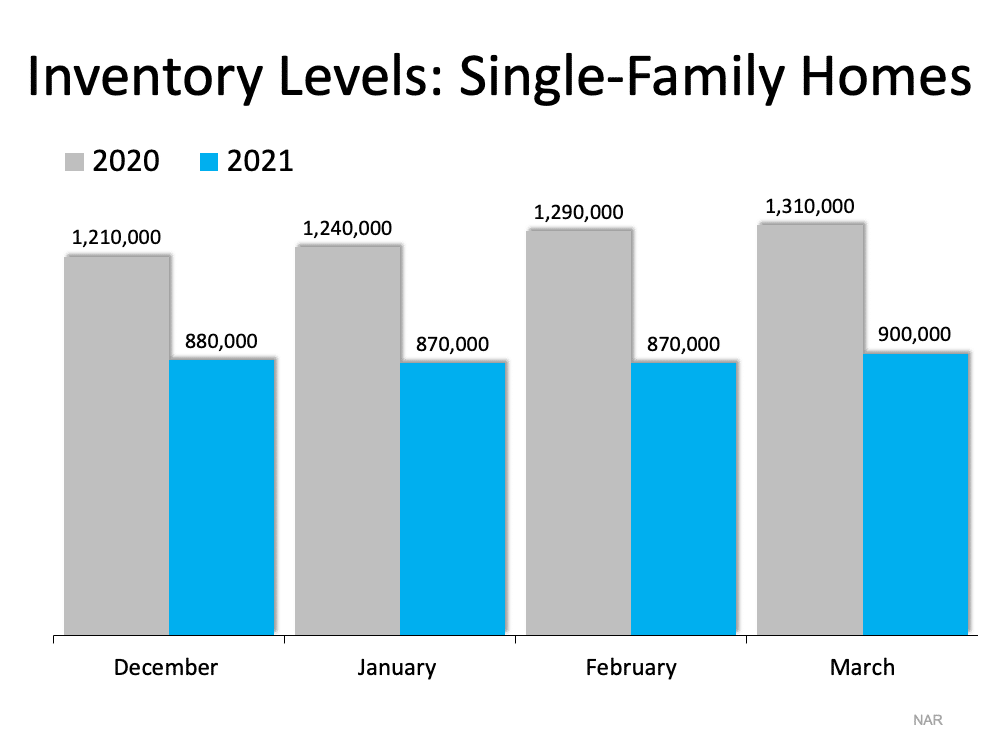
According to the National Association of Realtors (NAR), today’s housing inventory sits at an incredibly low 2.1-month supply, far below the 6-month mark for a neutral market. Inventory of single-family homes a year ago was already very low, and as you can see in the graph below, this year’s levels are even lower:Due to these market conditions, today’s buyers frequently enter fierce bidding wars while trying to purchase a home. This in turn drives up home prices and gives sellers incredible leverage in the negotiation process, two big wins if you’re going to sell your house this year.
Bottom Line
In such a hot market, it can feel as though the supply of homes has virtually dried up, leaving buyers to wander in an inventory desert. That’s why there’s never been a better time to sell. To a parched buyer needing to secure a home as soon as possible, your house could be a true oasis.
Selling a house is no small task. If you decide to try to do it on your own, keep in mind you’ll be responsible for all the expert-level work of a real estate professional.
The vital tasks an agent manages for you include listing and marketing your house, handling legal documentation, negotiating with all parties, and navigating local laws and regulations.
If you’re ready to sell while the market is in your favor, let’s connect to make sure you have the professional expertise you need every step of the way.
Over the past year, the pandemic made it challenging for some homeowners to make their mortgage payments. Thankfully, the government initiated a forbearance program to provide much-needed support. Unless they’re extended once again, some of these plans and the corresponding mortgage payment deferral options will expire soon. That said, there’s still time to request assistance. If your loan is backed by HUD/FHA, USDA, or VA, you can apply for initial forbearance by June 30, 2021.
Recently, the Consumer Finance Institute of the Federal Reserve Bank of Philadelphiasurveyed a national sample of 1,172 homeowners with mortgages. They discussed their familiarity with and understanding of lender accommodations that might be available under the Coronavirus Aid, Relief, and Economic Security (CARES) Act. The results indicate that some borrowers didn’t take advantage of the support available through forbearance:
“Most borrowers who had not used forbearance during the pandemic reported that it was because they simply did not need it. However, among the remainder, a lack of understanding about available accommodations may also be playing a role. Around 2 out of 3 in this group reported not seeking forbearance because they were unsure or pessimistic about whether they would qualify — even though a high fraction of borrowers are eligible for forbearance under the Coronavirus Aid, Relief, and Economic Security (CARES) Act.”
Here are some of the reasons why those borrowers didn’t opt for forbearance:
They were concerned forbearance may be costly
They didn’t understand how to request forbearance
They didn’t understand how the plans worked and/or whether they would qualify
If you have similar questions or concerns, the following answers may ease your fears.
If you’re concerned forbearance may be costly:
The Consumer Financial Protection Bureau (CFPB) explains:
“For most loans, there will be no additional fees, penalties, or additional interest (beyond scheduled amounts) added to your account, and you do not need to submit additional documentation to qualify. You can simply tell your servicer that you have a pandemic-related financial hardship.”
It’s important to contact your mortgage provider (the company you send your mortgage payment to every month) to explain your current situation and determine the best plan available for your needs.
If you’re not sure how to request forbearance:
Here are 5 steps to follow when requesting mortgage forbearance:
Find the contact information for your servicer
Call your servicer
Ask if you’re eligible for protection under the CARES Act
Ask what happens when your forbearance period ends
Ask your servicer to provide the agreement in writing
If you don’t understand how the plans work and/or whether you will qualify:
This is how the Consumer Financial Protection Bureau (CFPB) explains the program:
“Forbearance is when your mortgage servicer or lender allows you to pause or reduce your mortgage payments for a limited time while you build back your finances…
Forbearance doesn’t mean your payments are forgiven or erased. You are still obligated to repay any missed payments, which, in most cases, may be repaid over time or when you refinance or sell your home. Before the end of the forbearance, your servicer will contact you about how to repay the missed payments.”
The CFPB also addresses who qualifies for forbearance relief:
“You may have a right to a COVID hardship forbearance if:
You experience financial hardship directly or indirectly due to the coronavirus pandemic.
You have a federally backed mortgage, which includes HUD/FHA, VA, USDA, Fannie Mae, and Freddie Mac loans.
For mortgages that are not federally backed, servicers may offer similar forbearance options. If you are struggling to make your mortgage payments, servicers are generally required to discuss payment relief options with you, whether or not your loan is federally backed.”
Bottom Line
Like many Americans, your home may be your biggest asset. By acting quickly, you might be able to take advantage of critical relief options to help keep you in your home. Even if you tried to apply at the beginning of the pandemic and it for some reason didn’t work out, try again. Contact your mortgage provider today to determine if you qualify. If you have additional concerns, let’s connect to answer your questions and determine if there are other mortgage relief options in our area as well.
Are you looking for direct oceanfront condos for sale in Daytona Beach! Here is the list you have been looking for. It is updated every 15 minutes with the latest condos for sale along the beachside peninsula. From Ormond By The Sea down to Ponce Inlet and everywhere in between. My name is James Jestes I am a local Real Estate Broker here in the greater Daytona Beach area and I specialize in condos along the beach! Take a look at the list below and give me a call anytime to discuss your condo needs. I am here to help you make this real estate purchase a breeze!
Direct Oceanfront Condos For Sale In Daytona Beach
If you’re thinking about moving to the greater Daytona Beach area please give me a call at 386-315-4744 and let’s discuss your real estate needs. I am a full-time real estate broker with eXp Realty. I specialize in beachside condos and would like to help you find the right oceanfront condo. There are many condo buildings in the sand dunes of the Atlantic Ocean and they each have various differences. Let me help you navigate your condo search with ease! Please call me at your convenience.
It’s clear that consumers are concerned about how quickly home values are rising. Many people fear the speed of appreciation may lead to a crash in prices later this year. In fact, Google reports that the search for “When is the housing market going to crash?” has actually spiked 2450% over the past month.
“One of the most noteworthy things that came up in Inman’s conversations with agents was that every single one said they’ve had conversations with clients about whether or not the market is heading into a bubble.”
To alleviate some of these concerns, let’s look at what several financial analysts are saying about the current residential real estate market. Within the last thirty days, four of the major financial services giants came to the same conclusion: the housing market is strong, and price appreciation will continue. Here are their statements on the issue:
“Strong demand for housing looks sustainable. Even before the pandemic, demographic tailwinds and historically-low mortgage rates had pushed demand to high levels. … consumer surveys indicate that household buying intentions are now the highest in 20 years. … As a result, the model projects double-digit price gains both this year and next.”
“Homebuyers—interest rates are still historically low, though they are inching up. Housing prices have spiked during the last six-to-nine months, but we don’t expect them to fall soon, and we believe they are more likely to keep rising. If you are looking to purchase a new home, conditions now may be better than 12 months hence.”
“Unlike 15 years ago, the euphoria in today’s home prices comes down to the simple logic of supply and demand. And we at Morgan Stanley conclude that this time the sector is on a sustainably, sturdy foundation . . . . This robust demand and highly challenged supply, along with tight mortgage lending standards, may continue to bode well for home prices. Higher interest rates and post pandemic moves could likely slow the pace of appreciation, but the upward trajectory remains very much on course.”
“There are reasons to believe that this is likely to be an unusually long and strong housing expansion. Demand is very strong because the biggest demographic cohort in history is moving through the household-formation and peak home-buying stages of its life cycle. Coronavirus-related preference changes have also sharply boosted home buying demand. At the same time, supply is unusually tight, with available homes for sale at record-low levels. Double-digit price gains are rationing the supply.”
Bottom Line
If you’re concerned about making the decision to buy or sell right now, let’s connect to discuss what’s happening in our local market.
"As an Associate Broker with eXp Realty, I am dedicated to helping families and individuals accomplish their real estate goals by providing dedicated service when buying or selling a home. I have served my country in the U.S. Army and the U.S. Marines; I bring that same sense of service and selflessness to every one of my customers."